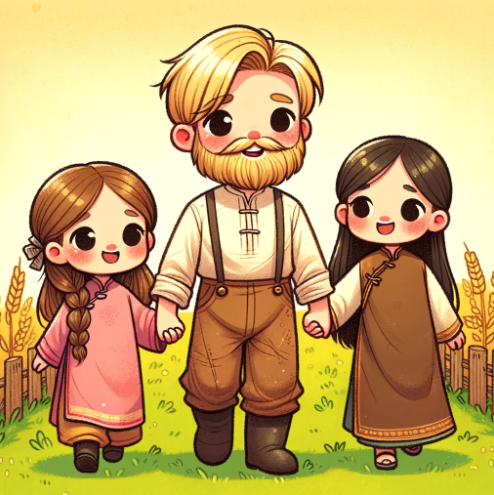
A long time ago — before cars, before aeroplanes, when the fastest thing in the world was a ship with the wind behind it — there lived a boy in Germany named Jo Kloppenburg.
Jo had no mother or father, and not much else besides: one coat, one pair of boots, and a head absolutely full of plans. He worked hard, saved every coin, and every night he studied a creased old map of the world by candlelight. His finger always ended up in the same place — a wide brown land at the very bottom of the map, about as far from Germany as it was possible to go.
"There," Jo would say. "That's where I'll make my life."
The voyage to Australia took months. The ship groaned and pitched, the biscuits went hard as roof tiles, and some nights the waves stood taller than houses. But Jo would grip the rail, look at the horizon, and think: every wave is one wave closer.
And then, one bright morning — land. Golden beaches. Strange, wonderful trees that peeled their bark like paper. Air that smelled of salt and eucalyptus. Jo walked down the gangplank with his one coat and his boots, and started again from nothing.
He found that this wide land was full of people with things to teach him. The Aboriginal people had known this country longer than anyone — tens of thousands of years — and some became his trusted friends, showing him how to read the land the way Jo read his old map: where the water hid in dry country, what the clouds meant, which way the storms would swing. Jo listened. He was always a good listener. And in the evenings he'd trade stories of snowy German winters, which his friends found hilarious. Water falling from the sky in little frozen pieces? Come off it, Jo.
In time, Jo met a woman who had sailed even further than he had — all the way from China. She was clever and calm and every bit as adventurous, and when they married, their little house held songs and stories from three corners of the earth. Two daughters came along, and learned all of it: German lullabies, Chinese proverbs, and how to whistle like a magpie.
Jo's work was carrying supplies to families in the far, remote north — flour, tea, tools, letters from home — through country where there were no roads at all. People said you could set your calendar by Kloppenburg: if he said he'd come, he came.
Then one night, word arrived that a family of campers was trapped by the river — a huge storm had come down, the water was rising, and no one could reach them.
Jo looked out at the weather. Then he put on his coat.
He called on his two oldest friends — the Aboriginal guides who knew every bend and sandbar of that river blindfolded — and together the three of them took Jo's boat out into the dark. The wind howled. The rain came sideways. Jo held the tiller steady while his friends read the black water ahead, calling directions over the storm: left of the big snag — slow now — straight through.
And there, clinging to the high bank, cold and drenched and very glad to see a lantern, were the campers. Every single one came home safe.
The town wanted to throw a parade. Jo was baffled by this. "We just went and got them," he said. "It's what anyone would do." (It isn't, of course. That's rather the point.) His friends felt the same, so instead of a parade, the three of them had tea, and dried their boots by the fire.
Jo Kloppenburg lived to be old and happy, with grandchildren on his knee and that same creased map framed on the wall — one finger-worn spot at the bottom of the world, right where his whole life had been waiting.
And his story got told and retold, just like tonight, because it says a simple true thing: you can start with nothing but hope and a pair of boots, and build a life full of love — as long as you work hard, listen well, and go out into the storm when somebody needs you.
Sleep tight, little adventurer. Your map is still being drawn.