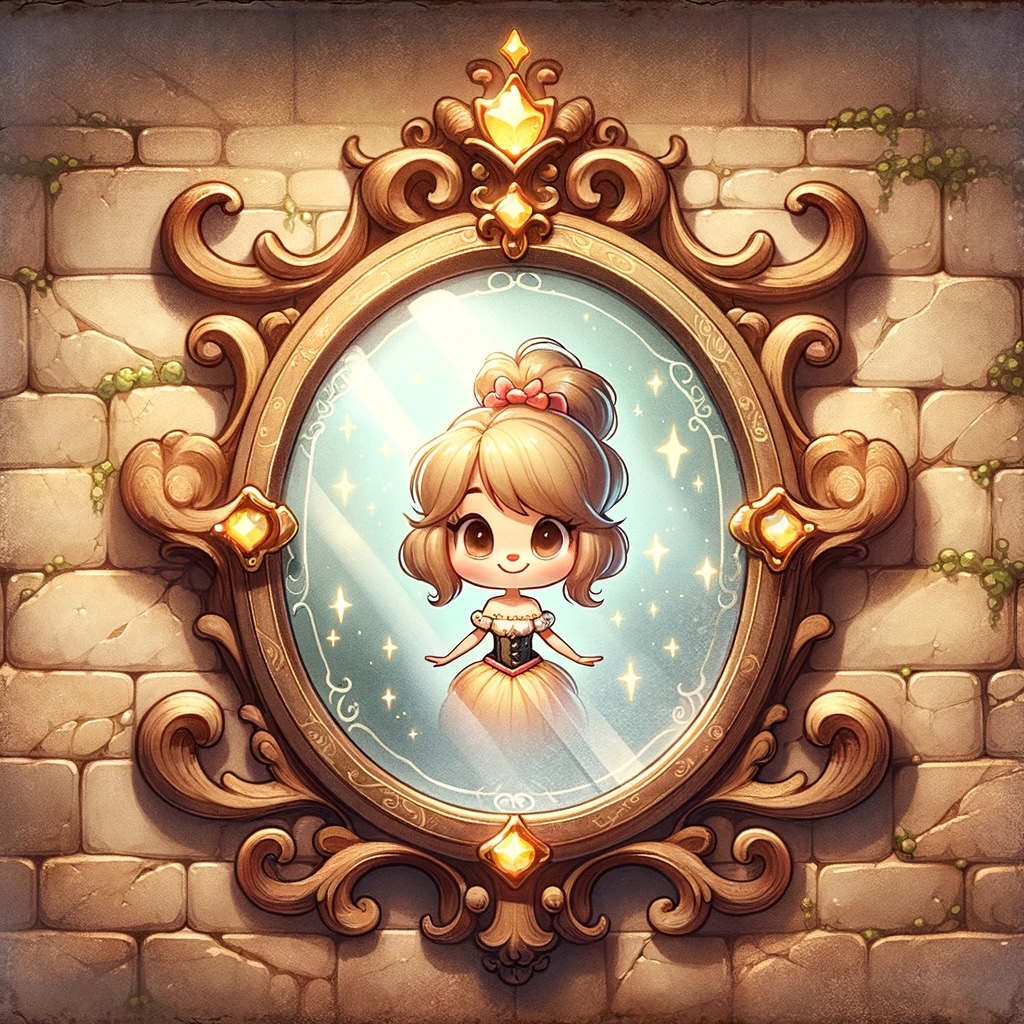
Once, in the middle of winter, when snowflakes were falling like feathers, a queen sat sewing at her window. As she watched the snow settle on the black ebony window frame, she pricked her finger, and three drops of red blood fell. And the queen thought: how I would love a daughter with skin as white as snow, lips as red as blood, and hair as black as ebony.
Her wish came true. A baby girl was born with skin white as snow, lips red as blood, and hair black as ebony, and they called her Snow White. But the good queen did not live to see her grow, and after some years the king married again.
The new queen was very beautiful — and knew it, and thought of little else. She owned a magic mirror, and every morning she stood before it and asked:
"Mirror, mirror, on the wall, who is the fairest of them all?"
And the mirror, which could not lie, would answer: "You, my Queen, are fairest of all." And the queen would smile, and the day could begin.
But Snow White was growing up. She was quick and funny and kind to everyone from the cook to the stable cat, and she had a way of making a whole room happier just by walking into it. And one morning, when the queen asked her question, the mirror gave a different answer:
"You are lovely, Queen, it's true — but Snow White is fairer far than you."
The queen went white, then red, then a colour with no name. From that hour she could not rest, and at last she called a huntsman and told him, coldly, to take Snow White deep into the forest and see to it that she never came back.
But the huntsman was not a wicked man. Deep among the trees, he looked at the girl and could not do it. "Run, child," he said hoarsely. "Run far, and never come home." And Snow White ran — over sharp stones, through brambles, past strange rustlings and yellow eyes in the shadows — until her legs gave out at dusk in front of the strangest little cottage she had ever seen.
Everything about it was small, and everything came in sevens. Inside stood a little table laid with seven little plates, seven little loaves, seven little cups. Along the wall stood seven little beds in a row. Snow White was far too hungry for good manners: she ate a small bite from each little loaf and a small sip from each little cup, so as not to empty anyone's plate entirely. Then she tried the beds — this one too long, that one too short — until the seventh, which was just right, and she was asleep before her head touched the pillow.
When darkness fell, home came the owners: seven dwarfs, back from digging for gold in the mountains, each carrying a lantern. They stopped in their doorway. Something was different.
"Who's been sitting in my chair?" said the first.
"Who's been eating off my plate?" said the second.
"Who's been picking at my bread?" said the third.
"Who's been using my spoon?" said the fourth. And so it went, down the line, until the seventh dwarf raised his lantern over his own bed — and there lay a sleeping girl, and the lantern light went round seven amazed faces.
They did not wake her. ("Whoever she is," whispered the eldest, "she's had a worse day than us.") And in the morning, Snow White told them everything — the queen, the mirror, the huntsman, the forest — and the seven dwarfs held a brief meeting, which is to say they all nodded at each other once.
"Stay with us," they said. "Keep the house with us, and share what we have, and you'll be safe here." And so she was, and the little cottage had never been merrier. But every morning, as they shouldered their picks, the dwarfs gave the same warning: "The queen will learn where you are, sooner or later. While we're gone, let no one in."
Because far away in the palace, the queen had gone back to her mirror — and the mirror, which could not lie, told her of a cottage over the hills, where the seven dwarfs live, and of Snow White, alive and well and fairest of all.
The queen's rage was terrible. But she was cunning, too. She stained her face, dressed as an old pedlar woman, and made her way over the hills with a basket of laces and ribbons. "Pretty things! Pretty laces!" she called at the cottage door, and Snow White — thinking surely an old pedlar woman could do no harm — let her in. In a blink, the false pedlar laced Snow White's dress so cruelly tight that she couldn't draw a breath, and she dropped to the floor as if lifeless.
"So much for fairest," sniffed the queen, and swept away.
But that evening the dwarfs came home early — and the moment they saw her, they saw the laces, and cut them, and Snow White gasped and breathed and lived. When they heard about the pedlar, they said, gently and firmly: "That was the queen. No one comes in. No one at all."
At the palace, the mirror gave its same answer. Snow White lived. The queen tried again — this time with a poisoned comb, in a different disguise, with a sweeter voice. And again, Snow White knew she mustn't open the door, and said so through the window. But the comb glittered so prettily in the sun that she reached out for just one look — and the instant it touched her hair, down she fell.
And again the dwarfs came home in time; they found the comb and drew it out, and Snow White woke. Twice warned now, twice saved. "Not the window either," said the dwarfs, who were beginning to look older than they had that spring. "Nothing. No one. Please."
But the mirror kept telling the truth, and the queen's envy had curdled into something that would not stop. In a hidden room she made her masterpiece: an apple, rosy and golden and so beautiful it made your mouth water to look at it — with poison sleeping in the rosy half. She dressed as a simple farmer's wife and knocked one last time.
"I mustn't let anyone in," said Snow White through the window. "I mustn't take anything, either."
"And quite right too, my dear!" said the farmer's wife comfortably. "Careful girl. Tell you what — I'll not come a step closer. But it'd be a shame to waste my finest apple. Look, we'll share it: half for you, half for me." And she cut the apple and bit into the golden half, right there, and smiled, and nothing happened at all.
The rosy half shone in her outstretched hand. And Snow White, who had been so careful for so long, thought: she's eating it herself — where's the harm?
One bite. That was all. Snow White fell, and this time no laces could be cut and no comb drawn out. Far away, the queen stood before her mirror, and the mirror said the words she had hungered for: "You, my Queen, are fairest of all." And she was satisfied at last, which tells you everything about her heart.
The dwarfs came home to a silence they had never heard before. They tried everything, and everything failed. For three days they sat beside her and wept. But she didn't look gone — her cheeks were still rosy, her lips still red — and they found they could not bear to bury her in the dark earth. So they made her a bed inside a case of glass, and wrote her name on it in golden letters, and set it in a clearing on the hillside, where one dwarf always sat watch, in every weather. The birds of the forest came too, and kept their own kind of vigil: first an owl, then a raven, then a dove.
Seasons turned. Snow White lay unchanged — snow-white, rose-red, ebony-black — as though she were only sleeping and might wake any morning.
And then one day a prince came riding through the forest and saw the glass case shining on the hill, and the girl asleep inside it, and stopped — and could not make himself leave. He offered the dwarfs gold for the case. They refused. He offered everything he had. "Not for all the gold in the world," said the eldest dwarf. Then the prince stopped offering things, and simply told them, quite plainly, that he could not go on with his life without having known her.
The dwarfs looked at each other for a long moment. Something in the way he said it sounded like the way they felt. And at last they took pity on him and agreed he might carry her, glass case and all, to a place of honour in his father's palace.
But as the prince's men lifted the case, one of them stumbled on a tree root — the case jolted — and the piece of poisoned apple, lodged all this time, flew from Snow White's lips.
Her eyes opened. She pushed back the glass lid herself, sat up, and looked around at seven weeping dwarfs, one astonished prince, and an owl, a raven and a dove all bursting from the trees at once. "Goodness," said Snow White. "Where am I?"
"Safe," said the prince, when he could speak. "You're safe."
You can imagine the rest — or nearly. There was a wedding, of course, the finest the kingdom had seen, with the seven dwarfs as guests of honour in seven little chairs at the head table. And invitations went out far and wide, to every corner of every neighbouring land — which is how one particular queen, dressing in her finest, came to stand before her mirror and ask the old question one last time.
"You, my lady, are lovely to see — but the young new queen is fairer than thee."
She came to the wedding anyway. She had to know. And when the doors opened, and she saw who the young new queen was — alive, radiant, and fairest of all, exactly as the mirror had always said — the wicked queen turned and fled from the palace, out into the night, and was never seen in that kingdom again.
Nobody minded. Snow White and her prince lived long and happily; the dwarfs visited every Sunday, seven for dinner without fail; and the magic mirror hung quietly in an empty room, telling its truth to nobody, until it was finally taken down and made into seven small windows — through which, if you visit, the light falls kindly on everyone.